News

  • Phone call with VSB District Principal for Learning and Information Zhi Su

    Yesterday we talked to Zhi Su, Vancouver School Board District Principal for Learning and Information, and he clarified some of the points that we had concerns about.

    These are the short summarized notes from that phone call.

    Age for Copilot

    Zhi Su confirmed that Copilot will only be made available for students over 13 years old. It would not be made available for elementary school students.

    Release Date

    There is no specific date for the release date of Copilot 13+ in schools yet. Zhi Su said the reason for this is that VSB is going through a consultation process, and until that is complete there is no formal date.

    What Copilot Can and Can’t be used for

    For what Copilot would or wouldn’t be used for in the classroom, Zhi Su said the decision is for teachers and schools to make. He said that Vancouver School Board’s role is to make resources like Copilot available for teachers. The BC Ministry for Education and Child Care prescribes the curriculum, and the teachers teach that curriculum.

    Similarly any discussion of opting out of using AI would be something to bring up with school administrators and teachers.

    Research on Negative Effects of AI on Learning

    Regarding research showing the negative effects of AI on learning, Zhi Su said that “the interesting thing about research is, if you go looking for it, you’ll find it”.

    He said that VSB works with the University of British Columbia and refers to research from them, and from the OECD. We have asked a follow-up question for information on which researchers and papers to refer to from UBC.

    Update: We received a reply from Zhi Su after we asked for some researchers or papers from UBC that VSB was referring to. He sent us link to the UBC Generative AI page. This is a website filled with AI-generated images, with no peer-reviewed scientific studies, or mention of the effects (positive or negative) of AI on learning.

    Use of Copilot 13+ at home

    Students will be able to log into their school’s Copilot 13+ restricted accounts from home to use the AI tools if they wish.
  • CBC Interview with Christina Walker

    CBC released an interview with Christina Walker, the Vancouver School Board’s Digital Literacy Mentor.

    The interview is relatively short but has many key omissions and mis-truths that are important to correct and clarify.

    Avoids mentioning harms of AI

    At the end of the piece the interviewer asks: “Have you noticed a decline in students when they’re using AI, whether it’s those critical thinking skills, whether their grades are going down? Is there any metric for that?”

    Christina Walker:
    “I wouldn’t say that there’s a metric. There isn’t really a metric just yet, other than, of course, having conversations and of course, as teachers, we are working in the classrooms, we are seeing what’s happening there.”

    This is incorrect, there are many different metrics used in research to evaluate the effect of AI on students. Scientific papers that use those metrics show that using generative AI harms learning.

    • AI-use is correlated with worse learning outcomes (Kosmyna 2025, Lehmann 2025), poorer critical thinking (Lee 2025), and makes users unable to accurately judge their own performance (Fernandes 2025)
    • Students that use AI perform worse than those that never used it (Bastani 2024) once the AI crutch is taken away.
    • A report from Microsoft themselves found that students that used LLMs as a study aid performed worse than students that just took notes (Kreijkes 2025).
    • A recent report from the usually AI-positive Brookings Institution was summarized by NPR as “The risks of AI in schools outweigh the benefits“.
    • The majority of students use it to solve problems for them, rather than learn from it (Anthropic 2025).

    As part of the BC Ministry of Education and Child Care’s Considerations for Using AI Tools in K-12 Schools document, it recommends that school boards “Seek AI tools with a proven track record of effectiveness backed by research or case studies demonstrating that they deepen learning for students.” (page 12)

    If the VSB is not aware of any metrics to evaluate the AI tools, what “track record of effectiveness backed by research or case studies” are they using to recommend AI use in schools?

    No mention of why AI is being deployed

    In the interview there is no mention of why VSB is choosing to deploy AI into classrooms.

    Does it help with test scores?

    Does it help students to retain information?

    If it has benefits, why are those benefits not mentioned?

    CBC does not ask this question.

    No mention of mental health issues

    Despite spending the first part of the interview talking about how many guardrails there are in Microsoft Copilot 13+, Christina Walker does not mention the host of problems associated with continued interaction with chatbots in general.

    Children are regularly using chat-bots for personal advice (Common Sense Media 2025). Putting a chatbot in the classroom can only increase this reliance on tools for emotional support.

    In adults “chat-bot psychosis“, caused by prolonged interaction with chat-bots, has affected many and has prompted a class-action lawsuit.

    Calculators, but not smart phones

    No discussion of AI in schools would be complete without mentioning the calculator. Everyone thought that calculators becoming popular would mean students would not learn how to add and subtract. But students can still do math so there was nothing to worry about.

    After bringing up calculators, Christina Walker mentions other technologies that have come out since the calculator: the internet and smartphones.

    So if calculators turned out to be not a problem, and we are applying the same logic AI, surely we would apply the same logic to the internet and smart phones? After all, everyone was worried about calculators, but students adapted.

    Curiously BC currently restricts cellphones in classrooms, with the reasoning that:

    By removing the distractions from digital devices, students can focus on their education. This leads to better learning outcomes and helps support their mental health and social connections.

    A distraction-causing digital tool that harms mental health and hurts social connections sounds a lot like AI.

  • Public Delegation Board Meeting Rejection

    Thank you to everyone who has suggested that we present our views and petition to the School Board in the monthly Public Delegation Board meetings.

    We applied to present on January 26, but were rejected with the following letter.

    Thank you for your interest in presenting at the January 26, 2026 Public Delegation Board meeting.

    Public Delegation Board Meetings are intended to provide members of the community with the opportunity to present to the Board on matters relating to governance and/or budget.

    The Board values receiving input and perspectives from community members and understand that the matter you have brought forward is important to you. After careful review by the Board Chair and Vice-Chair, your delegation request was not approved as it does not fall within the established guidelines for delegations to the Board, as outlined in Board Policy 7. The matter you wish to delegate on falls under operations, and your feedback would be better addressed by staff who are actively engaged on preparing an updated Acceptable Use of Technology guidelines to include responsible use of AI in the classrooms.

    Your request has been referred to the appropriate District staff for follow-up, and they will reach out to you to gather your input.

    We understand that the student-run campaign was also rejected.

    We heard back from District staff with an email to direct questions about the planned roll-out. We will collate questions and send them.

  • We are now PACES Vancouver

    We are pleased to announced that we are now the Vancouver chapter of PACES (Parents for AI Caution in Schools). PACES was founded in New York in 2025 by parents concerned about AI.

    From their website:

    Generative AI isn’t inevitable. Parents have the right to question how their children are being exposed to generative AI, and to ask critical questions about how AI affects brain development, learning capacity, critical thinking, and educational outcomes.

    We are the first chapter outside of New York, and we hope that by connecting with other grassroots campaigns, successes in one city can be used in others. We can share resources and strategies and feel less isolated.

    In news cycles dominated by press releases from multi-billion-dollar AI companies, it can feel like nobody is worried about the negative effects of children using AI.

    But you are not alone.

    There are teachers who are trying out banning AI in their classrooms, activists demanding a moratorium on AI in the classroom, and artists speaking out against AI.

    If you are a parent in Vancouver, please sign our petition and connect with us on social media.

    If you are a parent in another city, why not start a chapter of PACES in your own city!

  • Our First Poster Campaign

    Our First Poster Campaign

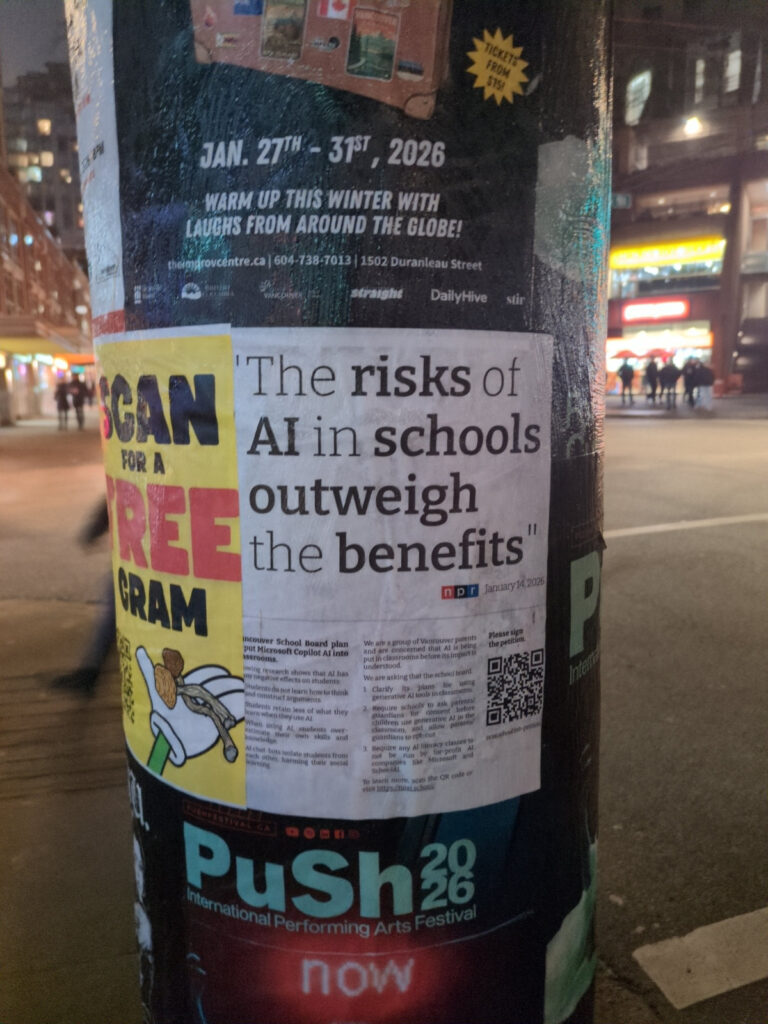
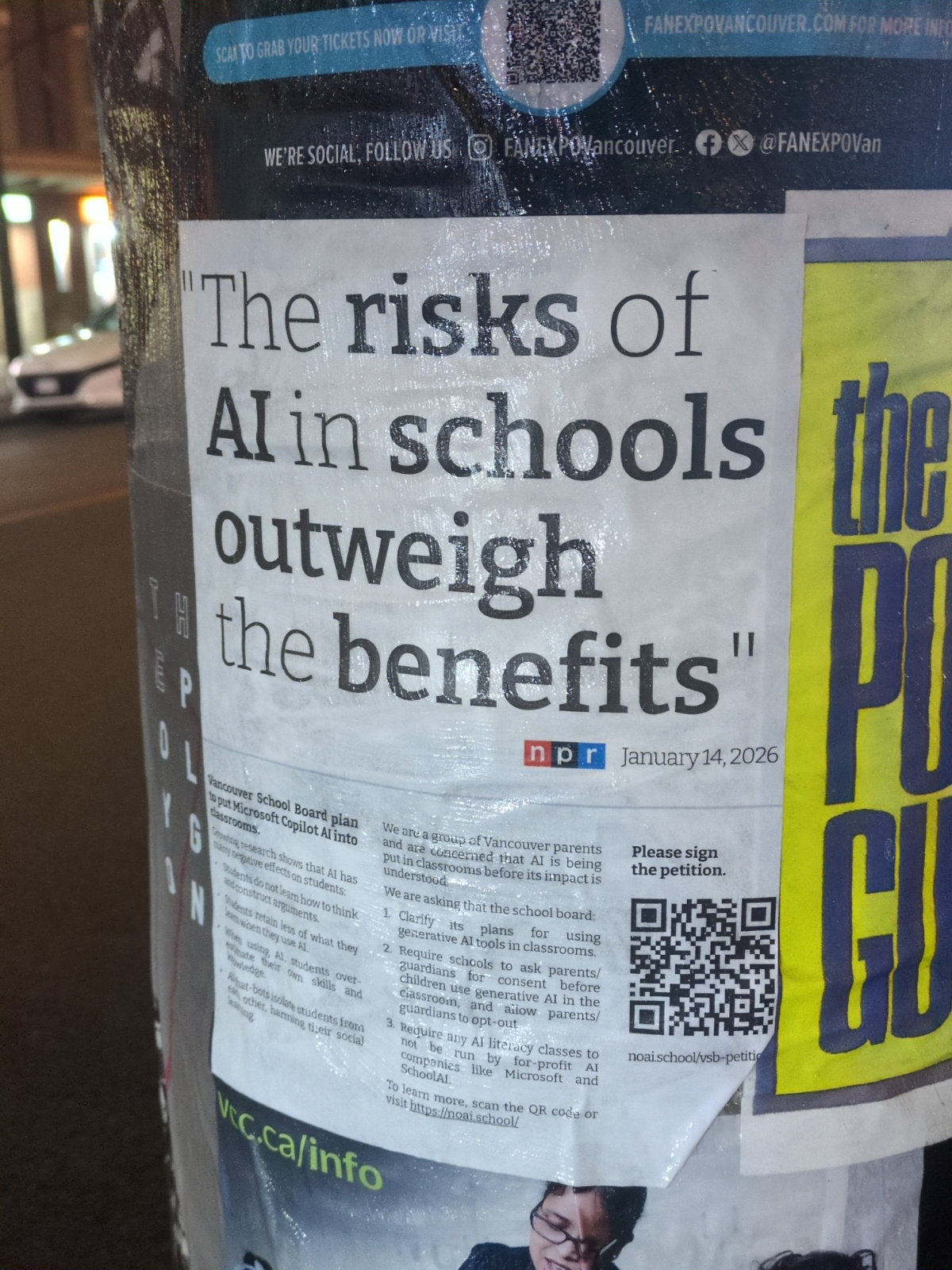
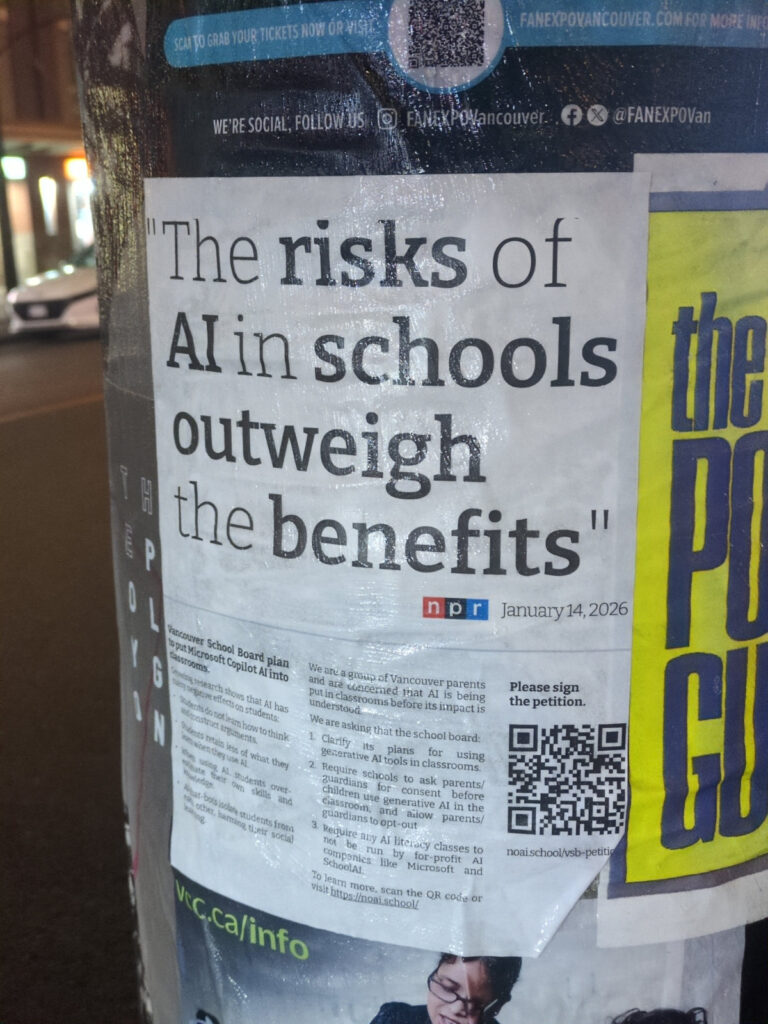
    Our first set of public awareness posters have started going up around downtown Vancouver!

    A lot of parents are unsure about whether AI is worth it for their children, but the recent NPR article summarized that the risks outweigh the benefits.

    The QR code goes to our Petition to Vancouver School Board.

    If you would like to print your own copies and put them up, feel free to download the attached PDF.